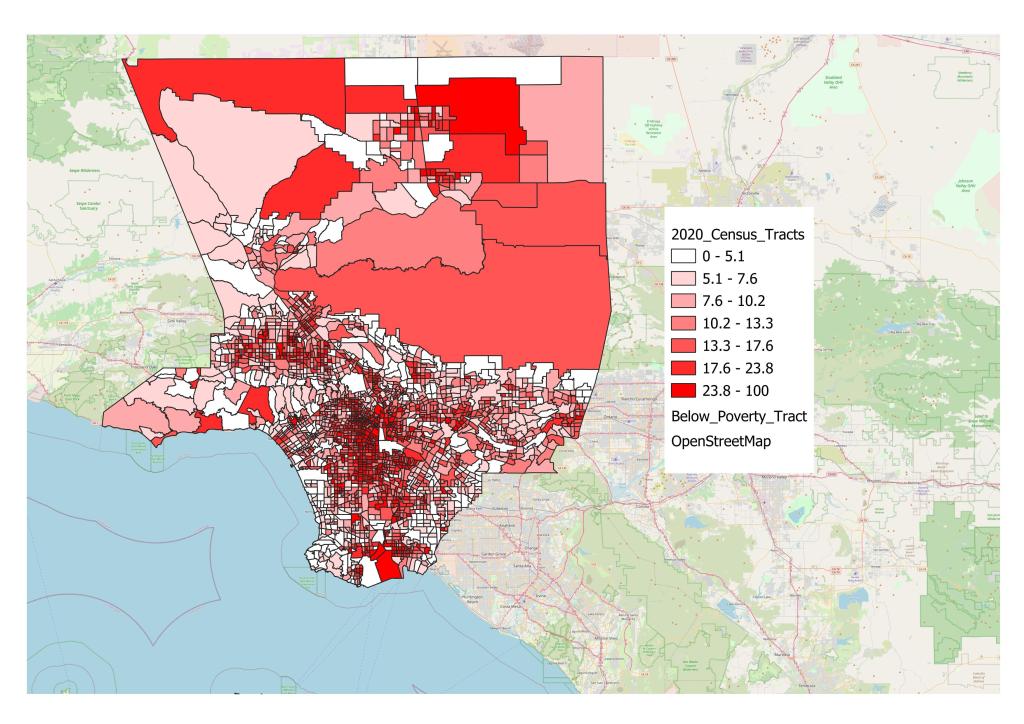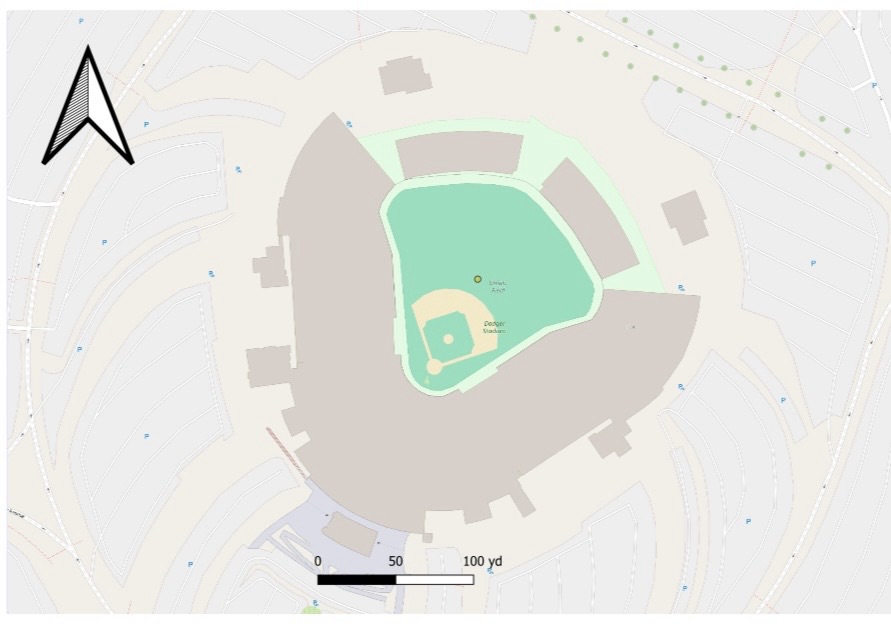
Dodger Stadium

Fetish Tolerance Inclusion Diversity Reconciliation Love
How Did We Get To Where We Are Today With People Living On The Streets?
.
Corporate America executives have not taken reductions in pay and benefits since 1980. Instead, their total compensation has skyrocketed. While union and typical worker wages stagnated, executive pay experienced historic exponential growth.
According to data from the EconomicPolicy Institute (EPI), inflation adjusted CEO compensation at the largest U.S. companies grew by 1,094%between 1974 and 2024.
The Exploding Pay Gap
Executive compensation shifted from being primarily salary based to heavily reliant on equity and market incentives.
Shifts in Benefits and “Golden Parachutes”
Unlike Standard labor contracts where benefits were cut, executive benefits were heavily enhanced and protected
Why Executive Pay Soared After 1980
Union workers have experienced significant, widespread cuts in pay, benefits, and retirement security since 1980, primarily driven by a structural shift known as “concessionary bargaining.”
1. The 1980s: The Era of Wage Concessions
The early 1980s marked a sharp turning point for labor power, triggered by the 1981–1982 recession, deregulation of major industries, and President Ronald Reagan breaking the PATCO air traffic controllers strike in 1981. This catalyzed a wave of historic rollbacks:
Two-Tier Wage Systems: To protect senior workers, unions were forced to accept “two-tier” structures. Introduced prominently by companies like American Airlines in 1983, these agreements mandated that newly hired union workers would permanently make significantly lower wages and receive fewer benefits than senior staff for doing the exact same job
2. The 1990s to 2010s: The Destruction of Benefits
As direct wage cuts stabilized, the landscape shifted toward dismantling the robust benefit packages unions had won in the mid-20th century.
Traditional private-sector pensions did not disappear overnight; instead, they gradually phased out between the mid-1980s and the early 2000s, replaced by employee-funded 401(k) plans. The number of single-employer pension plans in the United States peaked around 1985 and has declined steadily ever since.
According to data from the Federal Reserve Bank of St. Louis, the share of private-sector workers covered by traditional “defined-benefit” pensions plummeted from 59% in 1989 to just 21% by 2022, while 401(k)-style “defined-contribution” plans surged from 55% to 83% over the same timeframe.
1. Major Pension Terminations (The 2000s Crisis)
2. Historical Pension Takeovers (Pre-2000s)
3. The Structural Impact on Airline Labor
| Airline | Deficit Size at Crisis | Action Taken | Worker Outcome |
| United | ~$9.8 Billion | Terminated (PBGC Takeover) | Severe cuts up to 70% for some retirees. |
| US Airways | ~$2.3 Billion | Terminated (PBGC Takeover) | Massive cuts; plans held just 40% of required assets. |
| Delta | Multi-Billion | Partially Terminated | Pilots shifted to 401(k)s; other staff plans frozen. |
| American | ~$8.3 Billion | Hard Freeze | Accruals stopped; past benefits safely preserved. |
Beyond the major airlines, the largest corporate pension defaults and chronic underfunding crises in U.S. history occurred heavily within the automotive, steel, and manufacturing sectors. When the dot-com bubble burst and interest rates fell in the early 2000s, dozens of industrial giants saw their massive retirement pools crater into deep deficits.
1. The Automotive Giants
The Detroit automakers operated some of the largest private pension funds in the world, which became crushing financial burdens when car sales plummeted:
2. The Steel Industry Collapse
In the early 2000s, structural shifts, foreign competition, and massive “legacy costs” for retired workers completely wiped out the traditional American steel industry:
3. Notable Retail, Finance, and Tech Failures
Economic recessions led several massive household brands to completely default on their promises to workers:
Summary of Historic Corporate Pension Crises
| Company | Sector | Peak Deficit / Shortfall | Federal Takeover? |
| General Motors | Automotive | ~$20 Billion | No (Restructured) |
| Delphi Corp. | Auto Parts | $6.2 Billion | Yes (PBGC Absorbed) |
| Bethlehem Steel | Industrial | $3.7 Billion | Yes (PBGC Absorbed) |
| LTV Steel | Industrial | $1.9 Billion | Yes (PBGC Absorbed) |
| Sears | Retail | $1.4 Billion | Yes (PBGC Absorbed) |
| National Steel | Industrial | $912 Million | Yes (PBGC Absorbed) |
Signed by President Ronald Reagan, the Omnibus Reconciliation Act of 1981 slashed federal mental health spending by roughly 30%. It repealed the Mental Health Systems Act of 1980, ended direct categorical funding for community mental health centers, and replaced them with state-administered block grants.
1955 was the peak mental health population at 560,000 inpatients at state and county mental health hospitals. Adjusted for today’s population that would equal over 1.1 million people. Today there are about 750,000 people experiencing homelessness. Draw your own conclusions. Today the number of psychiatric beds is roughly 3% of its 1955 peak. We need to reimagine and rebuild the institution of mental health care in America.
Keep in mind, the Crack Epidemic began in the 1980s.






I noticed the cleaning guy at work looks like Ron Jeremy in the face. I mentioned it to him. He said, most people thought he looked like Danny Devito.

I said, oh yeah! You have Ron Jeremy’s head on Danny Devito’s body. Then I asked AI what it would look like if you put Ron Jeremy’s head on Danny Devito’s body. It answered, It would look like the guy that played the Penguin on Batman.
Then I asked AI to create a picture of Ron Jeremy’s head on Danny Devito’s body.

OLS
> fit.ols<-glm(usarea ~ lmhhinc + lpop + pnhblk + punemp + pvac + ph70 + lmhval +
+ phnew + phisp, data = philly2)
> summary(fit.ols)
Call:
glm(formula = usarea ~ lmhhinc + lpop + pnhblk + punemp + pvac +
ph70 + lmhval + phnew + phisp, data = philly2)
Coefficients:
Estimate Std. Error t value Pr(>|t|)
(Intercept) 534.491 164.270 3.254 0.00124 **
lmhhinc 2.462 12.176 0.202 0.83990
lpop -1.344 6.338 -0.212 0.83216
pnhblk 21.158 18.077 1.170 0.24260
punemp -5.097 63.645 -0.080 0.93622
pvac 371.699 58.427 6.362 5.96e-10 ***
ph70 -79.691 35.535 -2.243 0.02552 *
lmhval -45.668 10.458 -4.367 1.64e-05 ***
phnew 17.958 319.042 0.056 0.95514
phisp -56.308 30.695 -1.834 0.06741 .
—
Signif. codes: 0 ‘***’ 0.001 ‘**’ 0.01 ‘*’ 0.05 ‘.’ 0.1 ‘ ’ 1
(Dispersion parameter for gaussian family taken to be 4829.927)
Null deviance: 2938287 on 375 degrees of freedom
Residual deviance: 1767753 on 366 degrees of freedom
AIC: 4268.4
Number of Fisher Scoring iterations: 2
GWR
gwr.fit1<-gwr(usarea ~ lmhhinc + lpop + pnhblk + punemp + pvac + ph70 + lmhval +phnew + phisp, data = philly2.sp, bandwidth = gwr.b1, se.fit=T, hatmatrix=T)
> gwr.fit1
Call:
gwr(formula = usarea ~ lmhhinc + lpop + pnhblk + punemp + pvac +
ph70 + lmhval + phnew + phisp, data = philly2.sp, bandwidth = gwr.b1,
hatmatrix = T, se.fit = T)
Kernel function: gwr.Gauss
Fixed bandwidth: 1322.708
Summary of GWR coefficient estimates at data points:
Min. 1st Qu. Median 3rd Qu. Max. Global
X.Intercept. -1574.4098 -53.8875 88.4952 472.7282 3092.1466 534.4908
lmhhinc -151.0306 -7.0538 3.2205 22.3099 120.2753 2.4616
lpop -76.6700 1.1576 7.2067 20.4788 109.5747 -1.3441
pnhblk -124.9781 -2.0948 44.5163 100.0885 490.8730 21.1576
punemp -627.4200 -150.5909 -17.8892 69.6271 752.1507 -5.0966
pvac -1329.2458 2.5473 165.4452 343.9353 1108.9034 371.6993
ph70 -1028.8902 -161.7810 -43.4011 -8.2491 144.6265 -79.6910
lmhval -178.5925 -70.3725 -26.7389 -3.7657 89.1748 -45.6676
phnew -3747.6137 -484.6544 54.6557 734.6135 6434.5611 17.9575
phisp -313.3416 -24.9975 4.8295 117.2091 1533.6439 -56.3076
Number of data points: 376
Effective number of parameters (residual: 2traceS – traceS’S): 220.8092
Effective degrees of freedom (residual: 2traceS – traceS’S): 155.1908
Sigma (residual: 2traceS – traceS’S): 59.06332
Effective number of parameters (model: traceS): 178.5045
Effective degrees of freedom (model: traceS): 197.4955
Sigma (model: traceS): 52.3567
Sigma (ML): 37.9452
AICc (GWR p. 61, eq 2.33; p. 96, eq. 4.21): 4491.91
AIC (GWR p. 96, eq. 4.22): 3979.926
Residual sum of squares: 541379.3
Quasi-global R2: 0.81575
> gwr.b2<-gwr.sel(usarea ~ lmhhinc + lpop + pnhblk + punemp + pvac + ph70 + lmhval +phnew + phisp, data = philly2.sp, gweight = gwr.bisquare)
> gwr.fit2<-gwr(usarea ~ lmhhinc + lpop + pnhblk + punemp + pvac + ph70 + lmhval +phnew + phisp, data = philly2.sp, bandwidth = gwr.b2, gweight = gwr.bisquare, se.fit=T, hatmatrix=T)
> gwr.fit2
Call:
gwr(formula = usarea ~ lmhhinc + lpop + pnhblk + punemp + pvac +
ph70 + lmhval + phnew + phisp, data = philly2.sp, bandwidth = gwr.b2,
gweight = gwr.bisquare, hatmatrix = T, se.fit = T)
Kernel function: gwr.bisquare
Fixed bandwidth: 5092.898
Summary of GWR coefficient estimates at data points:
Min. 1st Qu. Median 3rd Qu. Max. Global
X.Intercept. -649.3890 -5.7699 134.6249 512.9574 2336.5957 534.4908
lmhhinc -180.3145 -4.4545 1.7487 13.7554 68.2914 2.4616
lpop -49.1608 1.2314 6.3430 19.0823 69.7005 -1.3441
pnhblk -106.4233 1.3658 41.0256 96.5291 285.2134 21.1576
punemp -397.5988 -143.8982 -6.2685 57.4553 729.4700 -5.0966
pvac -757.5534 8.8245 209.8576 370.7793 650.3669 371.6993
ph70 -643.0070 -207.9799 -66.3040 -19.8028 142.9682 -79.6910
lmhval -150.2726 -69.5496 -34.8198 -6.7118 107.7625 -45.6676
phnew -1844.6086 -418.1211 19.6153 509.9117 7421.2055 17.9575
phisp -221.0604 -26.5670 -7.5865 84.2566 1418.3152 -56.3076
Number of data points: 376
Effective number of parameters (residual: 2traceS – traceS’S): 132.4964
Effective degrees of freedom (residual: 2traceS – traceS’S): 243.5036
Sigma (residual: 2traceS – traceS’S): 62.2312
Effective number of parameters (model: traceS): 107.6713
Effective degrees of freedom (model: traceS): 268.3287
Sigma (model: traceS): 59.2826
Sigma (ML): 50.0803
AICc (GWR p. 61, eq 2.33; p. 96, eq. 4.21): 4316.932
AIC (GWR p. 96, eq. 4.22): 4117.761
Residual sum of squares: 943021.6
Quasi-global R2: 0.6790573
gwr.b3<-gwr.sel(usarea ~ lmhhinc + lpop + pnhblk + punemp + pvac + ph70 +
lmhval + phnew + phisp, data = philly2.sp, adapt = TRUE)
gwr.fit3<-gwr(usarea ~ lmhhinc + lpop + pnhblk + punemp + pvac + ph70 + lmhval +
+ phnew + phisp, data = philly2.sp, adapt=gwr.b3, se.fit=T, hatmatrix=T)
> gwr.fit3
Call:
gwr(formula = usarea ~ lmhhinc + lpop + pnhblk + punemp + pvac +
ph70 + lmhval + phnew + phisp, data = philly2.sp, adapt = gwr.b3,
hatmatrix = T, se.fit = T)
Kernel function: gwr.Gauss
Adaptive quantile: 0.02491844 (about 9 of 376 data points)
Summary of GWR coefficient estimates at data points:
Min. 1st Qu. Median 3rd Qu. Max. Global
X.Intercept. -1413.25718 2.04814 150.67770 593.38119 2856.09861 534.4908
lmhhinc -77.30238 -6.62505 2.08877 20.59832 121.03243 2.4616
lpop -71.53993 0.32328 6.55222 19.42020 93.59455 -1.3441
pnhblk -139.33868 -0.35274 39.43998 102.07286 462.87992 21.1576
punemp -592.27650 -109.64202 -3.93096 63.56270 623.38186 -5.0966
pvac -1410.12965 11.95427 193.34738 350.39251 1047.77143 371.6993
ph70 -975.65611 -190.62161 -67.38336 -13.17506 137.47857 -79.6910
lmhval -185.48730 -73.39044 -36.70912 -7.56967 48.91389 -45.6676
phnew -2570.54553 -577.37945 29.21937 654.40082 4045.23829 17.9575
phisp -182.91660 -29.72723 -7.23980 65.71058 771.29484 -56.3076
Number of data points: 376
Effective number of parameters (residual: 2traceS – traceS’S): 177.8408
Effective degrees of freedom (residual: 2traceS – traceS’S): 198.1592
Sigma (residual: 2traceS – traceS’S): 54.21695
Effective number of parameters (model: traceS): 135.2358
Effective degrees of freedom (model: traceS): 240.7642
Sigma (model: traceS): 49.18654
Sigma (ML): 39.35938
AICc (GWR p. 61, eq 2.33; p. 96, eq. 4.21): 4258.02
AIC (GWR p. 96, eq. 4.22): 3964.174
Residual sum of squares: 582484.4
Quasi-global R2: 0.8017605
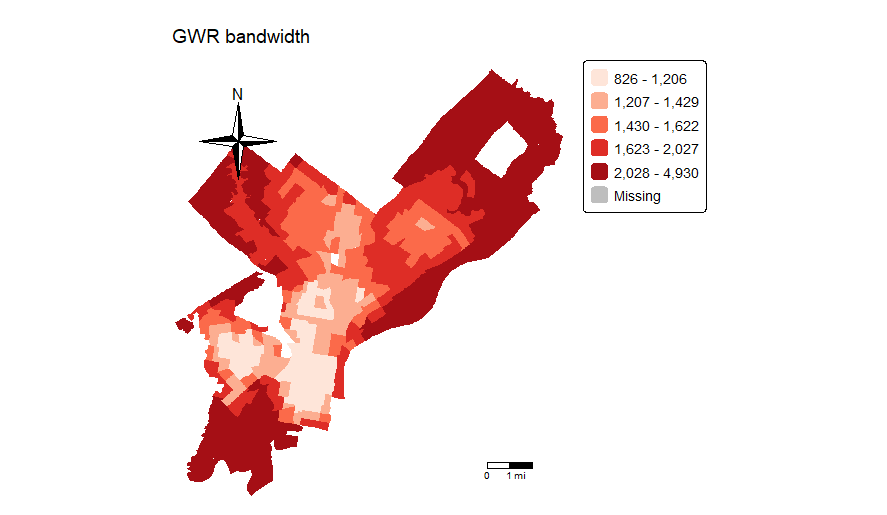
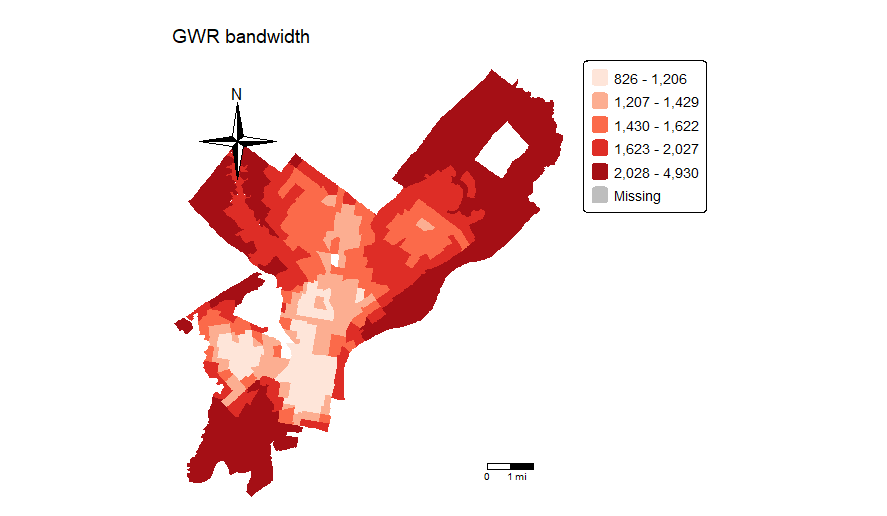
> gwr.fit1$bandwidth
[1] 1322.708
> philly2$bwadapt <- gwr.fit3$bandwidth
> tm_shape(philly2, unit = “mi”) +
+ tm_polygons(col = “bwadapt”, style = “quantile”,palette = “Reds”,
+ border.alpha = 0, title = “”) +
+ tm_scale_bar(breaks = c(0, 1, 2), size = 1, position = c(“right”, “bottom”)) +
+ tm_compass(type = “4star”, position = c(“left”, “top”)) +
+ tm_layout(main.title = “GWR bandwidth”, main.title.size = 0.95, frame = FALSE, legend.outside = TRUE)
I have been harassed without provocation or warrant by a crew of Vice detectives out of the Pacific Division. The D2’s name is Edward Acosta. He supervises 2 D1’s and he has employed his own son and the son of one of the D1s he supervises to assist in attacking me. The campaign of terror started in May and has continued until this week. I can present a case to you and supply you with plenty of evidence to prove my claim. They are transphobic. I have been targeted as the result of being transgender. I’m attempting to discern the best way to communicate this information to initiate an investigation with Los Angeles Police Department Internal Affairs.
Thank you,
Barbie